
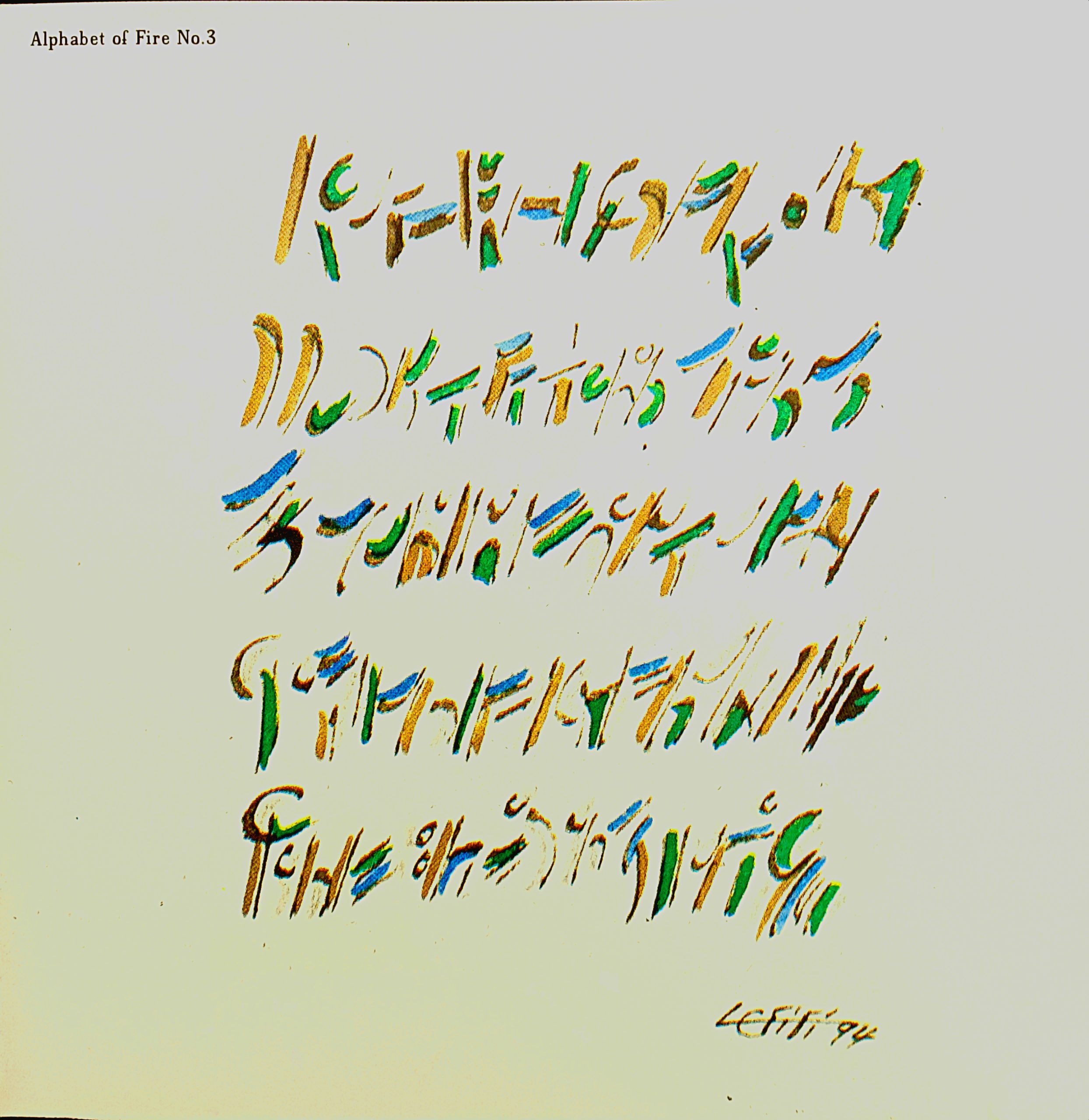
Lefifi Tladi, Alphabet of Fire No.3, 1994. Ink on Paper.
Alphabets of Fire
Percy Mabandu – 8 Dec, 2026
Painter, poet and onetime drummer of the Malombo Jazz Messengers, later Dashiki, Lefifi Tladi is a sagacious creative dynamo bent on clawing his way back into popular notice. A new generation of art lovers are fast gravitating towards a new discovery of his vast oeuvre.
Like a lightning disrupting darkness, think ignorance, as his name suggests, the 74-year-old septuagenarian genius is receiving a rising interest in his work and legacy against interesting odds. Though, as the saying goes, when the students are ready, the teacher comes along. It may well be that South Africa is finally ready for the perennial message of his art.
Tladi’s vast body of work stretches across painting in the abstract expressionist tradition, figurative drawings and forays into calligraphic modernism. The latter comprises ink on paper calligraphic forms that he calls Alphabets of Fire.
Guadeloupe-born and Swedish based scientist and writer, Claude Philogene has waxed lyrical about these drawings in a celebratory text titled Third Brain Calligraphy. Tladi first notably showed these drawings in an exhibition titled Xedzedze, (whirlwind) during 1995 at Unisa Art Gallery. The works made a symbolically salient appearance as cover art to Ingoma, a 1999 jazz record by late South African saxophonist and composer, Zim Ngqawana. Multiple other exhibitions have followed since.
Tladi first created his Alphabets of Fire to make a symbolic intervention just as South Africa was negotiating itself into a new age. The country was transitioning from apartheid-colonialism into a new democratic order. It was a time of great contest concerning not only the kind of society the new South Africa was going to become, but the meaning of art and the role of artists in that new society.
Importantly, the work sought to speak to a new nation needing to imagine new symbols, and a new liberated language to articulate itself. Alphabets of Fire were about pointing the people towards a consideration of that implied potential and the importance of a new requirement for collective creative work for a society.
Academic and writer, Michael Titlestad captures it well in his book, Making the Changes when he writes, Alphabets of Fire “stand for a new language” to express what Tladi considered a truly decolonised African personhood and society. It’s not too unlike the calls made by contemporary activists of the post-fees-must fall era.
Tladi spelled out some of his thinking in the catalogue of his joint retrospective exhibition in 1998 with the late Motlhabane oa Mashianwako, Oto La Dimo. He opines that, “under apartheid rule, the political, social, economic and, above all, the mental oppression of African people had culminated in a situation where the demand for change was non-negotiable… the ultimate aim was not political liberation only, but the decolonisation of the complete African being”.
As an artist he burned with a sharp clarity about the role of his art in that process. “My art is not in search of the past but in illuminating the future, in plotting new ways of seeing, feeling and thinking. I am trying to open up new scopes of perception or rather to restore our senses because apartheid had destroyed our peoples’ senses,” he writes.
It would be remiss to not remember Tladi was a notable member of the Black Consciousness movement. His work as a politically engaged artist also found expression in his work with Malombo Jazz Messengers which was later renamed Dashiki. Malombo jazz is a Pan-Africanist jazz idiom rooted in indigenous spiritual performance rituals.
It’s perhaps this octogenarian reach of his work that allows Tladi’s Alphabets of Fire to forego the usual tropes of protest art. He eschews easy slogans, propagandist posters or even depictions of the horrors of apartheid, reaching for a different visual register to articulate a liberation politics rooted in consciousness. The calligraphic drawings Taldi produces begin as a meditation on blades of flame in a living fire. Taking on the motif of fire, he aims to point us to the dynamism of a flame as flitting movement; an improvising fugitive energy that resists reification. He renders the flame with anthropomorphic stylisation and it takes on the look of dancing human figures becoming alphabetic forms. This keeps our minds on the centrality of human beings in his practice. Along with our unceasing pursuance of meaning.
Tladi is now in the winter of his years. He left the country of his birth in 1979 for exile in Botswana before settling in Sweden. Following the 1994 unbanning of anti-apartheid political parties and persons, he has kept homes in Stockholm and South Africa. A dual living arrangement recently disrupted by his need of regular dialysis on account of health challenges that come with age.
To be sure, this has not meant a decline in creative output. In fact, far from it. Tladi seems to have found a second wind as a painter and practising contemporary artist. His recent taking up of social media platforms like instagram bares this evidence. In fact, Tladi’s social media activities and his reignited creative output, seem set to push back against the grand art historical blindspots that continue to dog the South African art market and its thin memory. May the glare of his lightning’s light pursist and provide for a positive perception of a new path for us all.
Click to share article